
Google Search isn’t going anywhere. But search has changed.
Your business has spent years trying to get found on Google. But with AI now changing how people search, it’s time to look at the bigger picture.
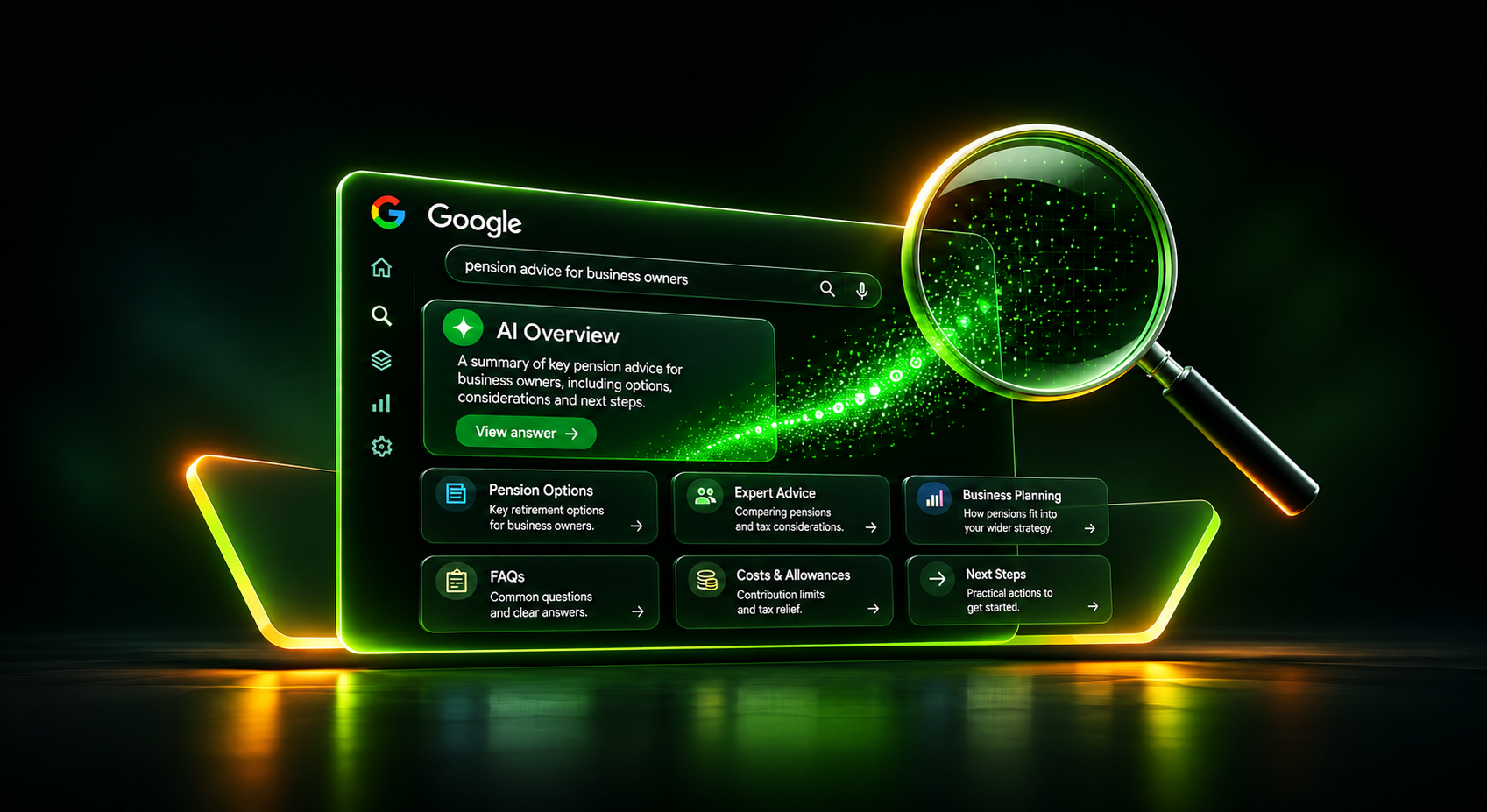
And rightly so. Google still matters. But the way customers research businesses is changing.
But prospective customers have additional ways to research their options. They can ask AI tools questions, explore providers and compare services without starting with a familiar list of website links.
So here’s the question: if your business is visible on Google, does that mean it’s being found everywhere else?
Not necessarily. And that’s why businesses need to understand both traditional search and AI-powered discovery.
Google still matters. A lot.
Let’s get one thing straight. Traditional search engine optimisation (SEO) isn’t dead. Google remains an important way for customers to find businesses, research services and compare providers.
Your website still needs to be technically accessible, relevant to the searches your customers make and genuinely useful. Good SEO helps with that. Google’s guidance also confirms that established SEO practices remain relevant to its AI search features.[1][2]
Commercial relevance matters too. Appearing for a phrase that attracts the wrong audience is different from being found by someone looking for your particular expertise. Rankings need to be considered alongside the customers and enquiries your business actually wants.
But customers have another way to find you
Think about someone researching a financial adviser. They could search Google for a particular service and work through the results. Or they could ask an AI tool:
“Which established firms specialise in helping business owners with complex financial planning?”
Instead of a ranked results page, they may receive an answer that discusses their requirements, mentions businesses or links to supporting information. Not every answer names providers, and not every platform uses or displays sources in the same way.[3][4]
For a business, those are different kinds of visibility. Being mentioned, being cited as a source and receiving a website visit are not interchangeable. Each tells you something different about how a prospective customer might encounter you.
Good Google rankings don’t tell the whole story
Your business might perform well for relevant Google searches without appearing in the AI answers your prospective customers see. Equally, an appearance in one answer doesn’t establish that you are consistently visible.
ChatGPT, Gemini and Google’s AI-powered search experiences do not operate identically. Google itself explains that AI Overviews and AI Mode can produce different responses and supporting links. Technical eligibility for Google’s features does not guarantee inclusion.[1]
The question matters as well. Someone asking for local financial advice may receive a different answer from someone describing a business sale or complex retirement needs.
A single result is a starting point, not a verdict. Before committing to changes, you need to understand which searches and questions matter, who appears alongside you and whether the same gaps recur. Otherwise, an isolated absence can become an expensive distraction.
The Search AI Perspective
Visibility isn’t simply about where you rank. It’s about whether you’re part of the conversation when customers are deciding who to trust.
At Search AI, we look at how businesses appear across traditional search results and AI-generated answers, alongside the competitors their customers are likely to encounter.
The important question isn’t simply where your website ranks. It’s whether your business is appearing when potential customers are researching their options, and whether the information they find reflects what you actually offer.
Context changes the interpretation. Being absent from a broad question may matter less than being overlooked in a specialist search that closely matches your services. A competitor appearing repeatedly deserves attention, but that appearance alone doesn’t explain why they were selected or what you should change.
That’s the gap worth investigating before committing more money to marketing. The purpose of comparison is to establish what deserves attention, rather than turn every difference into another recommendation for work.
What should businesses do next?
Start with a manageable set of questions, then investigate what the evidence tells you.
A complimentary Visibility Snapshot offers qualifying businesses an initial, point-in-time comparison. A paid Search Visibility & Intelligence assessment provides a more detailed investigation and prioritised recommendations. They serve different purposes; neither is a compulsory first step before commissioning other support.
Understand where you stand
You don’t need to chase every platform or react to every new feature. You need to understand how the customers you want are researching their options, and where your business enters that picture.
Before you spend more to get found, find out where you’re being overlooked.
Key takeaways
- Google remains an important channel for customer discovery.
- AI-powered search gives customers additional ways to find and compare businesses.
- Strong Google rankings do not guarantee inclusion in AI-generated answers.
- Understand your visibility before deciding where to invest.
EXPLORE YOUR SEARCH VISIBILITY
See where your business appears today.
Discover how your homepage compares with selected competitors across Google and AI search.